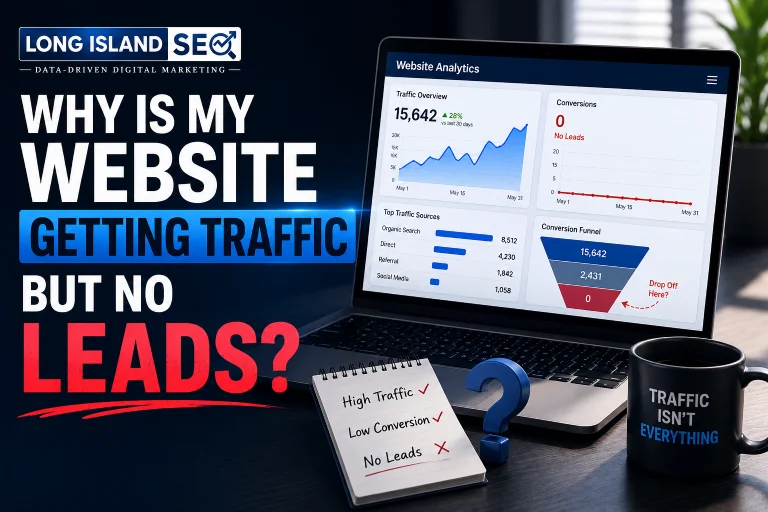
Website getting traffic to your website is a positive sign, but traffic alone doesn’t grow a business. If hundreds or even thousands of people visit your website each month and hardly anyone calls, submits a form, books an appointment, or makes a purchase, you have a conversion problem.
This situation is more common than many business owners realize. A website can rank well in Google and still fail to turn visitors into customers. The good news is that increasing leads isn’t always about getting more traffic. Sometimes, you need to make better use of the traffic you already have.
Here are the most common reasons your website may be getting visitors but not leads, and what you can do about them.
1. You’re Attracting the Wrong Traffic
Not all website traffic has the same value.
You might be getting visitors from informational searches, irrelevant keywords, broad geographic areas, or people who aren’t actually interested in buying your products or services.
For example, a local roofing company might receive traffic for a blog post about “how to fix a leaking roof.” That visitor may be looking for a DIY solution rather than a roofing contractor.
This is why SEO should focus on qualified traffic, not simply increasing the number of visitors.
Look at your Google Analytics and Search Console data to determine:
- ● Which keywords bring visitors to your website?
- ● Which pages receive the most traffic?
- ● Where are those visitors located?
- ● How long do they stay?
- ● Which pages generate calls or form submissions?
- ● Which search queries indicate buying intent?
A well-planned SEO strategy should target keywords that match what your potential customers actually search when they’re ready to take action.
2. Your Website Doesn’t Clearly Explain What You Offer
Visitors should understand what your business does within seconds of landing on your website.
If your homepage uses vague messaging such as “Innovative Solutions for a Better Future,” visitors may still have no idea what you actually sell.
Your headline should communicate three things quickly:
What you offer + who you help + why they should choose you.
For example:
“Long Island Roofing Company Helping Homeowners With Roof Repairs, Replacements & Storm Damage”
is considerably clearer than:
“Building Better Futures Together.”
Your visitors shouldn’t have to investigate your website to understand your service.
3. There Is No Clear Call to Action
One of the most common conversion problems is simply failing to tell visitors what to do next.
If someone reaches your service page and finds paragraphs of information but no obvious next step, they may leave.
Effective calls to action might include:
- ● Get a Free Quote
- ● Request an Estimate
- ● Schedule a Consultation
- ● Call Now
- ● Book an Appointment
- ● Get Your Free Audit
- ● Request More Information
Your CTA should also be easy to find. Don’t make visitors scroll through an entire page just to discover how to contact you.
For businesses that rely on inquiries, calls, and forms, every important service page should provide a clear path toward conversion.
4. Your Landing Pages Don’t Match Search Intent
Imagine someone searches Google for:
“Long Island emergency plumber”
and lands on a generic homepage.
That creates friction.
The visitor has a specific problem and expects a page that addresses that problem directly.
Instead, a dedicated landing page could explain:
- ● Emergency plumbing services
- ● Service area
- ● Common emergency situations
- ● Response times, where applicable
- ● Why customers choose the company
- ● Reviews or proof
- ● Frequently asked questions
- ● A prominent phone number or quote form
The same principle applies to Google Ads. Your ad should lead to a page that closely matches the searcher’s intent.
Long Island SEO’s Google Ads management services include landing page review and optimization specifically to help align ad traffic with conversion paths.
5. Your Website Is Difficult to Use on Mobile
A significant portion of local searches happen on smartphones. If your website is difficult to navigate on a mobile device, potential customers can disappear before contacting you.
Check your website on an actual phone.
Can visitors easily:
- ● Read your content?
- ● Tap your phone number?
- ● Complete your contact form?
- ● Find your address?
- ● Navigate between pages?
- ● Understand what you offer?
- ● See your CTA without excessive scrolling?
Mobile usability is particularly important for local businesses because someone searching for a service on their phone may be ready to call immediately.
A professional website design and development strategy should consider usability, speed, mobile responsiveness, navigation, messaging, and conversion, not just visual appearance.
6. Your Website Doesn’t Build Enough Trust
People rarely contact a business they don’t trust.
A visitor may be interested in your service but still ask:
“Why should I choose this company?”
Your website should answer that question.
Consider including:
- ● Customer reviews and testimonials
- ● Case studies
- ● Relevant certifications
- ● Years of experience
- ● Portfolio examples
- ● Before-and-after results where appropriate
- ● Service areas
- ● Photos of your team or work
- ● Guarantees or policies, when applicable
- ● Clear contact information
Don’t simply tell visitors that you’re the best. Show them evidence.
For example, Long Island SEO’s portfolio showcases completed projects and measurable outcomes, helping potential clients evaluate the company’s work rather than relying solely on promotional claims.
7. Your Forms Are Too Complicated
Every additional field can create friction.
If your goal is to generate leads, ask only for information you genuinely need at the first step.
A simple form might request:
- ● Name
- ● Phone
- ● Website
- ● Brief description of the project
You can collect additional information later.
Also check whether your forms actually work. Test them yourself regularly and make sure submissions are reaching the right person.
A broken contact form can quietly turn a high-traffic website into a zero-lead website.
8. Your Website Is Too Slow
A visitor may never become a lead if they leave before the page finishes loading.
Slow websites can create a poor user experience, particularly for mobile visitors and people browsing on slower connections.
Review:
- ● Page loading speed
- ● Image sizes
- ● Unnecessary scripts
- ● Hosting performance
- ● Caching
- ● Core Web Vitals
- ● Mobile performance
Website speed shouldn’t be viewed only as an SEO issue. It’s also a conversion issue.
If visitors have to wait, they’re more likely to move on to another business.
9. Your Content Doesn’t Address Customer Concerns
Sometimes a website explains what a company does but doesn’t answer the questions that prevent visitors from taking action.
Potential customers may want to know:
- ● How much does it cost?
- ● How does the process work?
- ● How long does it take?
- ● What areas do you serve?
- ● What makes you different?
- ● Do you work with businesses like mine?
- ● What happens after I submit the form?
- ● Why should I choose you instead of a competitor?
Your service pages and supporting content should address these questions clearly.
Good content isn’t simply written to rank in Google. It should help a potential customer feel confident enough to take the next step.
10. You’re Measuring Traffic Instead of Leads
This may be the biggest issue of all.
If you’re celebrating a 50% increase in organic traffic but haven’t checked whether leads increased, you’re measuring the wrong outcome.
Track metrics such as:
- ● Qualified leads
- ● Form submissions
- ● Phone calls
- ● Appointment bookings
- ● Quote requests
- ● Conversion rate
- ● Cost per lead
- ● Revenue generated
Traffic is an input.
Leads and revenue are business outcomes.
Long Island SEO’s approach emphasizes qualified traffic and measurable business growth rather than simply chasing rankings. Its SEO process combines keyword research, competitor analysis, on-page optimization, content, and link building to support business objectives.
A Simple Website Conversion Checklist
Before spending more money trying to generate additional traffic, review your existing website.
Ask:
- ● Am I attracting people who actually need my services?
- ● Is my offer immediately clear?
- ● Does every important page have a strong CTA?
- ● Do my landing pages match search intent?
- ● Does the website work well on mobile?
- ● Can visitors easily contact me?
- ● Does the website demonstrate trust and credibility?
- ● Are my forms short and functional?
- ● Does the website load quickly?
- ● Am I tracking calls, forms, and other conversions?
If several answers are “no,” fixing those issues could be more valuable than simply trying to increase traffic.
Should You Focus on More Traffic or Better Conversions?
Usually, you need both – but the priority depends on where the problem exists.
If your website receives almost no relevant visitors, you need to improve your SEO and other traffic-generation channels.
If you’re receiving significant qualified traffic but very few inquiries, your focus should shift toward conversion rate optimization, landing pages, messaging, trust signals, and calls to action.
And if you need immediate visibility while your organic presence develops, Google Ads can provide another source of high-intent traffic.
The goal isn’t simply to get more people to your website.
The goal is to turn the right visitors into customers.
Final Thoughts
A website with traffic but no leads isn’t necessarily failing at SEO. It may be attracting the wrong audience, communicating the wrong message, creating too much friction, or simply failing to give visitors a compelling reason to take action.
Start by analyzing where your visitors come from and what they do once they arrive. Then improve the pages, messaging, CTAs, forms, trust signals, mobile experience, and tracking.
If you’re unsure where the problem is, a professional website and SEO audit can help identify the gaps between visibility, traffic, and conversions.
If your website is attracting visitors but isn’t generating the leads your business needs, you can request a free quote from Long Island SEO to discuss your website, SEO, and digital marketing goals.