When someone needs a roofer, an accountant, or help with local SEO, they often start with a Google search. However, the results they see today may look different from the traditional list of blue links.
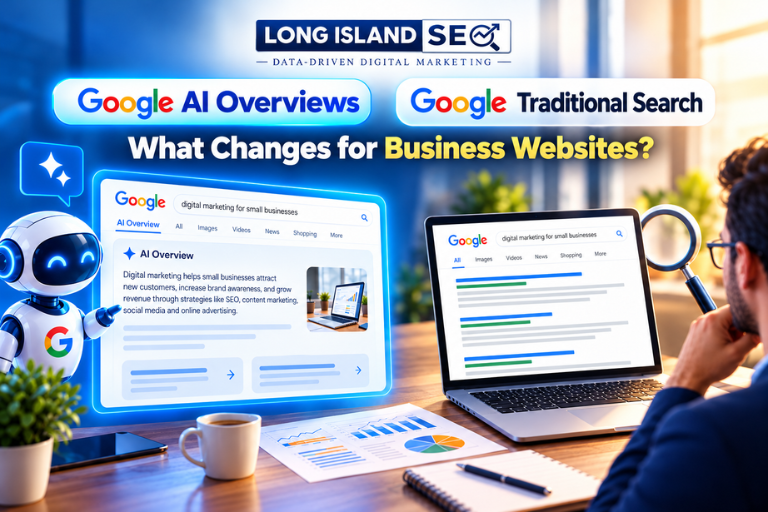
Google AI Overviews vs Traditional Search highlights this change in how people discover information online. Traditional Google Search displays relevant web pages for users to explore, while AI Overviews provide AI-generated summaries with links to supporting sources for certain queries. Although AI Overviews do not appear in every search or replace traditional organic results, they can influence how users find websites and decide which links to visit.
For any business that relies on organic traffic, the practical question is this: if Google answers more questions directly on the results page, what happens to the visits, leads, and calls that might otherwise begin with a click?
My view is that businesses should neither panic nor ignore the change. The sensible approach is to understand what’s different, measure your own search performance, and make changes based on evidence rather than assumptions.
What Is the Difference Between Google AI Overviews Vs Traditional Search?
Traditional Google Search generally presents a list of relevant web pages, alongside features such as local listings, images, videos, and featured snippets. Users scan the results and choose which links to visit.
Google AI Overviews take a different approach. They provide an AI-generated summary for certain searches, bringing together information from multiple sources and offering links that users can follow to explore a topic further.
The main difference is how information is presented.
Traditional search encourages users to compare individual results. AI Overviews can give users an initial answer before they decide whether to visit a website.
For example, someone searching for “how much does local SEO cost?” may see traditional organic results linking to agency pages and pricing guides. With an AI Overview, they may first see a summary of factors that affect pricing, followed by links to sources for more detail.
This does not mean traditional results have disappeared. AI Overviews appear when Google’s systems determine they can add value to a particular search. Many searches still display results without an AI Overview.
For businesses, both formats matter. A website can benefit from traditional organic visibility while also having an opportunity to be shown as a supporting source in an AI Overview.
How Do AI Overviews Change the Way People Find Websites?
AI Overviews can change the journey between a customer’s question and a website visit. Some users may get enough information from the summary to move on. Others may follow a link because they need more detail, want to compare options, or are ready to take action.
This makes search intent especially important.
Consider three types of searches:
- Informational: “What does an SEO audit include?” A user may find a basic explanation in the overview but visit a website for a detailed checklist or examples.
- Commercial research: “SEO agency vs in-house SEO team.” The user may need additional context, comparisons, and practical considerations before deciding.
- High-intent: “SEO company in Long Island.” The searcher may be looking for providers, service details, reviews, and a way to get in touch.
The effect of AI Overviews can vary across these searches. A simple informational query may be answered quickly, while a complex decision may require more research and website visits.
This is why businesses should avoid assuming that every search will produce fewer clicks. The impact depends on the query, the search results shown, the user’s needs, and the usefulness of the pages available.
The goal is not simply to appear in more searches. It is to be visible when potential customers need the information, expertise, or services your business provides.
What Do AI Overviews Mean for Organic Traffic and Click-Through Rates?
AI Overviews can affect how often people click through to websites, particularly when they find enough information directly in Google Search. However, the impact varies by query, search intent, and the results displayed.
A drop in clicks does not automatically mean AI Overviews are responsible. Changes in rankings, search demand, and competition can also affect performance.
Business owners should look at several metrics together:
- Impressions: How often your pages appear in Google Search.
- Clicks: How many people click through to your website.
- Click-through rate (CTR): The percentage of impressions that result in clicks.
- Conversions: Whether visitors complete meaningful actions, such as submitting an enquiry, booking a consultation, or making a purchase.
- Engagement: Whether visitors find what they need and continue exploring your website.
Use Google Search Console to compare clicks, impressions, and CTR by page and query over time. Then review your analytics data to understand whether organic visitors are converting.
If traffic dips but leads remain steady, that may be an acceptable trade-off. What deserves attention is the opposite situation: your website attracts plenty of visitors, but few turn into enquiries. We explain some of the possible reasons in our post on why a website gets traffic but no leads.
The important thing is to investigate changes before deciding what needs to be improved. Traffic alone does not tell you whether your SEO is delivering business value.
Can Business Websites Appear in Google AI Overviews?
Yes. Google can show links to eligible web pages in AI Overviews, but there is no guaranteed way to make a page appear.
Google’s official guidance states that the established SEO fundamentals remain relevant to AI features. Pages need to meet Google’s technical requirements and be eligible to appear in Search. Being eligible does not guarantee that Google will index a page or display it in an AI Overview.
Businesses should focus on the fundamentals rather than searching for a special AI ranking trick.
That means:
- Publishing useful, reliable content that addresses real customer questions.
- Making important pages accessible to search engines.
- Using clear headings and logical page structure.
- Linking related pages so visitors and search engines can discover relevant content.
- Ensuring that important information is available as text.
- Keeping structured data accurate and consistent with visible page content.
There is no special AI schema that guarantees inclusion in AI Overviews. Adding unnecessary markup or inserting keywords into every heading will not replace a sound SEO strategy.
If a page is not being indexed, start by investigating the underlying issue. Our guide to 10 technical issues that can prevent Google from indexing your website explains common problems worth checking.
How Should Businesses Adapt Their SEO Strategy for AI Overviews?
Businesses do not need an entirely separate SEO strategy for AI Overviews. They need a website that answers questions well, provides a reason to visit, and supports the next step in the customer’s decision.
1. Answer customer questions clearly
Give readers a direct answer near the beginning of a page when the topic calls for one. Use descriptive headings, concise explanations, and lists where they make information easier to understand.
For example, a page about SEO pricing should explain the factors that affect cost before moving into detailed service descriptions. A technical SEO audit page should clearly explain what the audit covers and why it matters.
Clear writing helps visitors find information quickly, regardless of how Google displays the result.
2. Go beyond information that every competitor publishes
A basic definition is easy to reproduce. Useful detail gives a reader a stronger reason to visit your website.
Depending on the subject, that could include a practical comparison, a decision-making checklist, original research, examples, expert commentary, or a clear explanation of trade-offs.
Do not add an example simply to make a page longer. Include it when it helps the reader understand the subject or make a better decision.
For service businesses, this is particularly important. Potential customers need more than a general explanation of a service. They may want to understand the process, what affects the outcome, which approach suits their situation, and what to expect next.
3. Build connected content around your services
A single blog post rarely answers every question a potential customer may have. Related articles and service pages should work together.
For example, an SEO agency might publish articles about technical SEO, keyword research, local search, and website performance. Those articles can link naturally to relevant service pages when readers need more detailed help.
Internal links help visitors discover related information and make important pages easier to find. They should support the reader’s next step rather than being added simply to increase the number of links.
4. Maintain strong technical SEO
Useful content cannot perform well in search if search engines struggle to access or understand the page.
Review crawlability, indexation, mobile usability, redirects, canonical tags, page experience, and internal linking. Make sure important service information is accessible to search engines.
Technical SEO does not guarantee an AI Overview placement. It helps establish the conditions needed for your pages to be discovered and considered in Google Search.
5. Measure outcomes, not just rankings
Rankings remain useful, but they do not tell the whole story.
Track which pages attract relevant search impressions, which queries generate clicks, and whether organic visitors become leads or customers. Review these results regularly instead of making major changes in response to a single week’s performance.
A practical SEO strategy should connect search visibility to business goals. If a page receives traffic but produces few enquiries, the problem may involve search intent, the content, the offer, or the conversion experience – not just rankings.
Businesses looking for support with these areas can explore Long Island SEO’s SEO services to understand how technical, on-page, and broader SEO work can support organic visibility.
Does Every Business Need to Change Its Content Strategy?
No. A business should not rewrite its entire website simply because Google has introduced AI Overviews.
Start by reviewing which search queries matter most to your business and how your important pages currently perform. Then decide whether a page needs clearer answers, more useful detail, stronger internal links, or technical improvements.
A service page that already attracts relevant visitors and generates enquiries may need very little change. A thin article that repeats information available on dozens of other sites may need a more substantial review.
Prioritize changes based on evidence and business value. Avoid tactics that promise guaranteed AI visibility, and do not sacrifice readability to make content sound as though it was written for a machine.
The strongest approach is to improve pages for the people who use them while maintaining the SEO fundamentals that help search engines discover and understand them.
How Can Businesses Measure the Impact of AI Overviews?
Businesses can now use Google Search Console’s Generative AI performance report to monitor their website’s visibility in AI Overviews and AI Mode. Google rolled out these reports to websites worldwide on August 31, 2026.
The report provides impression data and lets website owners review which pages appear in generative AI features, along with information such as country, device, and performance over time. It does not provide a complete breakdown of clicks and conversions specifically from AI Overviews.
To evaluate performance:
- Establish a baseline. Record the current performance of your most important pages and search queries.
- Review AI visibility. Use the Generative AI performance report to identify pages receiving impressions in AI Overviews and AI Mode.
- Compare search performance. Review clicks, impressions, and CTR in your regular Search Console reports.
- Check business results. Use your analytics platform to understand whether organic visitors are submitting enquiries, booking consultations, or completing other valuable actions.
- Investigate meaningful changes. Account for seasonality, search demand, ranking changes, and other factors before attributing a performance shift to AI Overviews.
Do not assume that a rise in AI impressions will automatically produce more website traffic or enquiries. Use the available data to understand visibility, then evaluate whether it supports your business goals.
For detailed instructions, refer to Google’s official Generative AI performance report documentation.
A Practical Checklist for Business Owners and Marketing Managers
Use this checklist when reviewing your website’s readiness for changes in Google Search:
- Review important pages and make sure they answer customer questions clearly.
- Track search impressions, clicks, and conversions together.
- Check which pages are appearing in AI Overviews and AI Mode using Search Console’s Generative AI performance report.
- Improve content that lacks useful detail or a clear purpose.
- Maintain technical SEO fundamentals and useful internal links.
- Avoid anyone promising guaranteed placement in AI-generated answers.
You do not need to change everything at once. Start with the pages and search queries that matter most to your business.
Final Thoughts
Google AI Overviews are changing how people discover information, but they do not remove the need for useful business websites. Traditional organic results still matter, and people may visit a website when they need more detail, want to compare options, or are ready to take action.
Focus on creating genuinely helpful content, maintaining sound technical SEO, and measuring whether search visibility leads to meaningful business outcomes. Use the available reporting to guide decisions rather than reacting to every new search feature.
If you want to understand how your website is performing in organic search, get in touch to discuss your SEO goals and opportunities.